
(Tompkins Weekly, 9-11-24, by Jaime Cone Hughes)
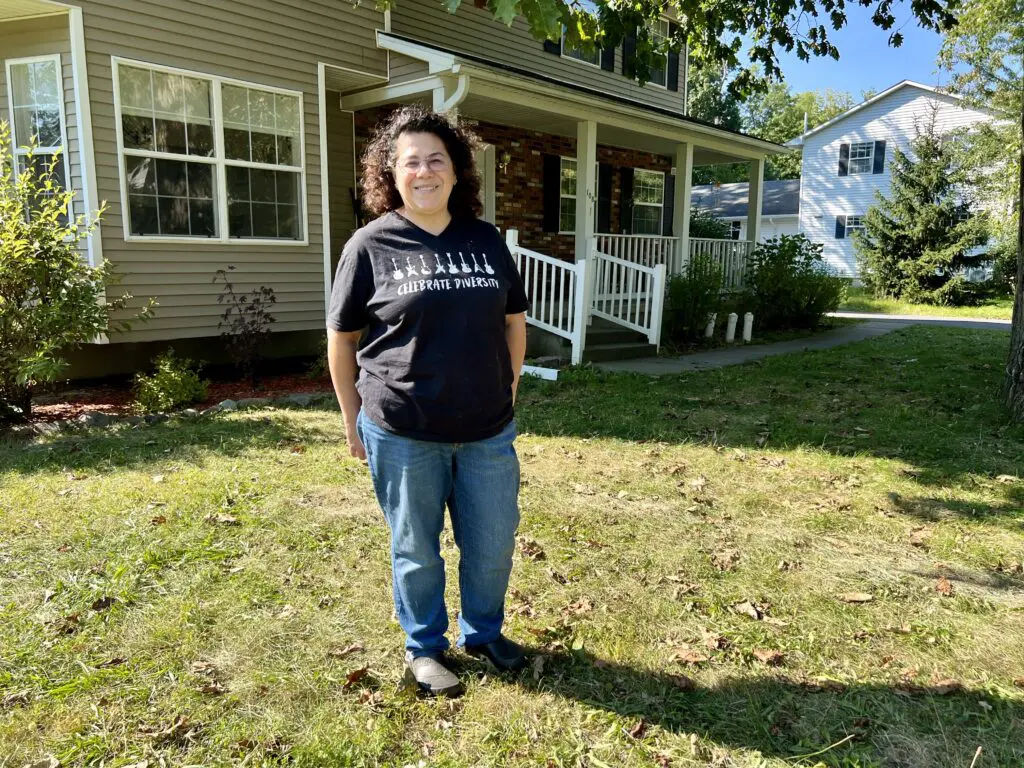
In 2022, when Florencia Ardon purchased the northeast Ithaca duplex on Briarwood Drive that she had called home as a renter for 10 years, she received some disheartening news from the home inspector: the building’s two water heaters would soon need to be replaced.
It made Ardon anxious to think about them breaking down, but the cost to replace them was overwhelming.
“I started looking at what it would cost to change out the water heaters, and I was quoted just regular gas, and it was over $8,000 per water heater,” she said, adding that she would need to purchase two, one for each two-bedroom apartment.
“I was freaking out because I was thinking, many people say just wait, and if it dies then it dies, but as a very small landlord, I cannot have my tenants without hot water,” she said. “Everything takes so much time to get installed, so it was worrying me.”
The other family in the building has young twin children.
“If the [water heater] dies in the middle of winter, what are they going to do with two babies? It was very concerning to me,” Ardon said.
With some help from the Smart Energy Choices program, which covers several counties throughout the Southern Tier, including Tompkins County, Ardon was able to replace the water heaters and also install heating and cooling upgrades to her home. Several local experts guided her through the process, and she said that the end result was affordable and has made her home, as well as that of her renters, more comfortable and energy efficient.
With $39.6 million now available to low- and moderate-income residents in the state to help them save money on their energy bills, New York state is the first in the nation to offer the first phase of funding of the Inflation Reduction Act’s (IRA) Home Electrification and Appliance Rebates (HEAR) program.
The funding, which was announced by the Gov. Kathy Hochul’s office in June, expands the already-existing EmPower+ program, allowing more families in need to make energy efficiency improvements and electrification upgrades.
“This new funding means that it’s a great time to do home energy upgrades,” said Leigh Miller, community energy advisor for Smart Energy Choices, a program of Cornell Cooperative Extension Tompkins County.
“Heating bills can add up, especially because here we heat for a lot of the winter,” said Miller, “but specifically, I’m thinking about prices.”
In 2023, the state Public Service Commission approved three-year rate plans for customers of NYSEG and Rochester Gas and Electric Corporation (RG&E).
Under the new rate plan, a NYSEG residential electric customer using 600 kilowatt-hours per month saw an average total monthly bill increase of $9.94 (10.3%) starting in November 2023; an $8.88 (8.4%) increase starting in May 2024; and will see an $11.34 (9.9%) increase starting in May 2025, according to the New York Department of Public Service.
“Gas and electric rates both saw increases the past year, multiple times, and there will be another increase in the spring,” Miller said. “It’s a good time to weatherize so you’re not having to go higher than you need to with heating costs.”
Through the program EmPower+ there were $5,000 and $10,000 grants already available for weatherization and heating systems, she said. “Add in the new funding — that means there is a lot available right now. It means up to $14,000 on top of those grants, so in total you might be looking at $24,000 or $19,000 in funding.”
There are other resources available as well, including a free home energy assessment to see what could be improved and what funding could be available for specific improvements.
Over 649 Tompkins County lower-income households participated in the low-income program between January 2018 and January 2024, Miller said.
With the $10,000-plus in grants for eligible households, a homeowner could add additional insulation, air sealing and door sweeps, and make sure the windows have proper caulking. These efforts, especially when combined, can have a significant impact on both comfort and energy usage, according to Miller.
With a free assessment by an approved local contractor, a homeowner would receive all of the information about how their home could be more efficient and decide which projects to implement. They could be worth pursuing, Miller said, as small cracks and gaps that allow air in can add up to the same heat or cool air loss as leaving a window open all year long.
“Once air is escaping from somewhere, it has to be brought in from another area,” Miller said. “A little crack really does have an impact on your heat escaping.”

The funding can also be used to replace inefficient appliances, especially refrigerators and water heaters.
Homeowners can also access thousands of dollars to install heat pumps. There are special incentives for people residing in certain parts of Lansing and Ithaca, Miller said, and Smart Energy Choices can help people use all of the incentives they might be eligible for to their maximum advantage.
Heat pumps are becoming increasingly popular for their efficiency and ability to maintain a stable temperature, and Miller said people also find them easy to use as well.
According to NYSERDA, heat pumps outsold natural gas furnaces in 2022 and outsold them at a higher margin in 2023.
“So based on the national numbers, they’re gaining in popularity,” Miller said. “Folks with climate motivations can pair it with solar electricity and be more on the greener side of things.”
Despite their positive qualities and increased prevalence, the relatively high cost of installing heat pumps can be prohibitive for the average homeowner. The incentives available are designed to alleviate some of that expense, and there are multiple reasons to switch to heat pumps.
“There are lots of benefits to them,” Miller said. “They have just been financially out of reach to install for a lot of folks. This new funding kind of turns the tables.”
There are two types of heat pumps: air-source and ground-source.
Geothermal (ground-source) heat pumps take advantage of the constant temperature of the shallow earth (40°-70°F) to efficiently exchange temperatures, heating homes in the winter and cooling homes in the summer.
Air-source heat pumps have been used for many years in nearly all parts of the United States, except in areas that experienced extended periods of subfreezing temperatures. However, in recent years, air-source heat pump technology has advanced so that it now offers a legitimate space heating alternative in colder regions, according to the United States Energy Department.
For example, a study by the Northeast Energy Efficiency Partnerships found that when air-source units designed specifically for colder regions were installed in the Northeast and Mid-Atlantic regions, the annual savings are around 3,000 kWh (or $459) when compared to electric resistance heaters, and 6,200 kWh (or $948) when compared to oil systems.
Ardon found that for her, air-source heat pumps with heat-pump water heaters made sense.
Fred Ebel, of Ithaconstruction, who was hard at work at Ardon’s home doing some of the repair work following the installation of the new equipment, said he is in favor of the new all-electric systems.
“As far as I’m concerned, if it helps the environment, I’m all for it,” Ebel said. His company did not install Ardon’s heat pump, but he advised those considering purchasing one to use a professional installer.
“I think you need to have a little more than homeowner skills to install one,” he said. “It could be dangerous.” Smart Energy Choices can help homeowners to find qualified installers.
In addition to needing new water heaters, Ardon was also not particularly happy with her electric wall-mounted air conditioning units.
“They were super noisy, and they blasted arctic air,” she said, adding that modulating the air temperature throughout the house was difficult with the wall units, and they were so loud that it was hard to watch television in the same room with them.
Heating the house was “okay,” Ardon said, “but the baseboards I hated, always, in the way they lowered the actual amount of space because a bed, for example, can’t be flush with the wall.”
For all these reasons, Ardon thought it time to pursue other heating and cooling options.
Ardon spoke to Jack Wright, PowerHouse educator at Cornell Cooperative Extension Tompkins County, who recommended she speak to Gay Nicholson, president at Sustainable Finger Lakes.
“Gay was great at helping me navigate communication with possible installers, requirements to apply for different funding, and more,” said Ardon. Some of the programs she ultimately qualified for were:
- Clean Energy & Equity Pilot grant as part of the Electrify Tompkins heat pump pilot from Sustainable Finger Lakes
- Lansing Non-Pipeline Alternative rebate (through NYSEG)
- State’s EmPower+ program through NYSERDA
- NYS Clean Heat Rebate
“They did a fantastic job,” Ardon said about the installation of the new air source heat pumps, ductless heating and cooling wall units in the living room and two bedrooms, and 50-gallon heat pump water heaters with new electric circuits and expansion tanks for each unit.
She said that her electricity consumption and electric bill this summer, with the new units cooling the house, is about one third of what it was with the wall air conditioning units. Ardon also tried to be more conscious of how she and her two children, 18 and 15 years old, use electricity, and they took measures to lower their energy consumption.
“In the end, what happened is the whole project, which included the removal of everything, installing the heat pumps, new water heaters, and the heat pumps — all of that was above $70,000,” Ardon said. “Now, with all the rebates, it came down to a little more than $16,000.”
NYSERDA granted Ardon a loan with 4% interest for 10 years.
“Between paying that loan and paying the electricity, it’s still lower than what I was paying to NYSEG, and everything is much nicer,” she said.
Also, heat pumps are eligible for 30%, up to $2,000, in federal tax credits.
Ardon said she is very happy with the end result. “The heat pumps are so quiet; it is fantastic,” she said.
Renters can take advantage of these same benefits, as well. Those who qualify and rent in a one-to-four-unit home can also participate; they just need to get their landlord on board, Miller said.
“The way it works is that tenants who fall into the income requirements are qualified,” she explained. “Say you have a two-unit building, and one resident meets the qualifications; both units could receive funding.”
Miller acknowledged that navigating the many options available can be challenging, and she encouraged those who are interested to visit Smartenergychoices.org, contact smartenergychoices@cornell.edu of call (607) 366-0833 for more information.
For those who are in need of immediate assistance in paying their heating bills this winter, New York’s Home Energy Assistance Program (HEAP) is designed to help eligible New Yorkers heat and cool their homes. The program also offers emergency benefits if you are in danger of running out of fuel or having your utility service shut off. For assistance, contact the Tompkins County Department of Social Services at 607-274-5264.

